Line is 9 vehicles. Pick a market below. When the light turns amber the camera counts for ≈55 s — here compressed to 10.
Bet on Traffic: How Live Traffic Camera Betting Works
Yes — you can bet on real traffic. Rush Hour by 155.io points computer vision at a live traffic camera, counts the vehicles crossing a marked zone, and settles Under, Over, Range or Exact bets roughly every 55 seconds. No random number generator is involved.
18+ · ≈65 rounds an hour is the real risk of this format · the operator margin applies on every one of them

What betting on traffic actually is
A new category of casino game in which the event you bet on is a real street, filmed live, and the result is a machine count of what drove past.
Betting on traffic belongs to a genre called the CCTV Game, launched in January 2026 by the iGaming studio 155.io under the slogan “Betting on Chaos”. The debut title, Rush Hour, is the one this whole site is about: a fixed camera looks at a junction in one of seven cities, a computer-vision model counts the vehicles that cross a marked detection zone, and you bet on what that number will be when a short window closes.
That makes it different from both of the things it superficially resembles. It is not sports betting: there is no fixture, no form guide and no team to know — the “event” repeats roughly every 55 seconds, all day, on a camera that never stops. And it is not a slot: there is no reel, no paytable of symbols and no random number generator deciding the outcome. What you are betting on is the same footage you can watch on screen, which is exactly why the format is easy to understand and easy to underestimate.
The third thing to understand early is that “real world” does not mean “fair value”. The operator prices every line with a margin, the published return for Rush Hour is 90.00–92.16%, and the round frequency — up to about 65 rounds an hour — is what turns small stakes into a large turnover. We will keep coming back to that, because it is the single most important thing the game’s marketing leaves out.
One match, hours apart
Over/Under on a fixture you can research. Markets close, the game is played, you wait. Edge comes from knowing more than the line.
A generator decides
Every spin or curve is produced by software with a published RTP. Nothing to watch, nothing to verify except the maths certificate.
A road decides, ≈55 s at a time
You watch the feed that settles your bet. No RNG — but no information edge either: the line already knows the feed is busy.
How a round works
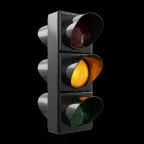
Red, amber, green. The traffic light at the top of this page is not decoration — it is the literal shape of one round.
Seven fixed cameras — Tokyo, Lyon, Sydney, London, Paris, Bucharest, Bangkok. Same angle every round; the game tells you which city you are watching, not the exact junction.
A marked area on the lanes. The computer-vision model tracks moving objects and registers each one at the moment it crosses that zone.
Under, Over, Range or Exact. Before bets close the result hash is already committed (SHA-256), so the count cannot be edited afterwards.
Every crossing adds one. The number arrives in bursts, because a signal upstream releases traffic in waves — see how the signal cycle shapes the count.
The final number settles all four markets at once. A few seconds later the next round opens on the same feed — about 65 times an hour.
Two details matter more than they look. First, the count is machine-made: a human is not tallying cars, and what the model treats as “a vehicle” depends on how detection is configured for that feed. Motorbikes, scooters and buses are the obvious edge cases, and the answer differs by city — we cover it on the traffic-camera page. Second, the window is short and fixed, so the line moves with the feed and the time of day rather than with anything you know about the city. A busy camera simply gets a higher line, not an easier bet.
The four markets
Drag the line and tap a market. Green cells are the counts that would pay — it shows why Exact pays the most and lands the least.
Illustration of which counts settle each market. It says nothing about odds: the operator sets payouts so that, over thousands of rounds, it keeps its margin.
Under. The count finishes below the line. Together with Over this is the closest thing to an even-money bet in the game, and the market most people start with.
Over. The count finishes above the line. Tempting on a feed that looks busy — but the line is set from that same feed, so “busy” is already priced in.
Range. The count lands inside a band of a few numbers. Narrower than a total and wider than Exact, and priced between them.
Exact. One number. The highest payout and the lowest hit rate. Played “for fun” every round at 65 rounds an hour it is the fastest way to drain a balance.
When a market is right depends on the spread of the feed, not on your intuition about the city. A wide, multi-lane camera produces counts that scatter; a single-lane feed clusters tightly around its line. Watching two or three rounds before staking tells you more than any rule of thumb — the longer version is on how to bet on traffic.
Real world instead of RNG
The genre’s whole pitch in one sentence: the outcome is produced by a street, not by a generator. True — and it is worth being precise about what that does and does not buy you.
Slot or crash game
- A random number generator picks the result the instant you press the button.
- The animation you watch is a replay of a decision already made.
- Fairness is a certificate: you trust the lab that tested the RNG.
- Return to player is published; house edge is the rest.
Traffic camera
- The result is the number of vehicles that really crossed the zone in the window.
- The footage you watch is the event itself, with normal stream delay.
- Fairness is a commitment: a SHA-256 hash of the result is published before bets close, with an open verifier and round lookup by ID.
- Published RTP 90.00–92.16% (155.io); house edge is the rest.
So yes: nothing in a traffic round is scripted, and you can check that the count you were paid on refers to the round you watched. That is a genuine step up in transparency from a slot, where the honest answer to “what just happened?” is “a number was drawn”.
What it does not do is move the odds in your favour. Unpredictable is not the same as exploitable. You cannot audit the detection model, you cannot see the next round in the current one, and the operator sets the line and the payouts with the same margin it would apply to any other game. Real-world randomness replaces the generator; it does not replace the house edge.
- Before bets close
- SHA-256 hash of the result is published — a sealed envelope
- After the round
- the count is revealed and must match the hash; the hash chain is pre-committed, so no round can be swapped in
- You can check
- any past round by its ID in the operator’s open verifier (spec: docs.155.io)
- You cannot check
- the detection model itself or the margin built into the line
Which cities you can watch
Seven cameras across seven time zones — which is the one genuinely useful thing to know before you open the game: somewhere it is always rush hour, and somewhere it is always 3 a.m.
 CAM · TOKYO
 CAM · SYDNEY
 CAM · LONDON
 CAM · PARIS
 CAM · LYON
 CAM · BUCHAREST
 CAM · BANGKOK
typical weekday rush hour (07–10, 16–19 local)daytimenight
Local clocks above are live; the “rush hour” label is the usual weekday pattern for a big city, not a measurement of the feed — the studio does not publish per-camera counts, and we do not invent them. The practical reading is simple: when Europe goes quiet overnight, Sydney and Tokyo are in their daytime, and the counts on those feeds behave very differently from a half-empty Paris boulevard. Each city guide covers what the camera shows, when the local traffic peaks and how that lines up with your own time zone: Tokyo, London, Paris, Sydney. Lyon, Bucharest and Bangkok are in the game too; their guides follow later.
Where it is available
Rush Hour and the wider CCTV Game range went live with Stake, Shuffle and Roobet in February 2026. Take the exit for the operator you already use — the game is the same at each.






No bonuses and no promo codes on this site — only whether the game is in the lobby, with a check date. Availability differs by country and a title can be missing from a lobby even where the site itself is reachable; the where-to-bet page lists what to check before depositing.

Traffic vs the rest of the genre
155.io has pointed cameras at more than roads. This site stays on the traffic side of the line.
The same studio runs Snow Run (how many skiers pass a gate; launched 31 March 2026, multipliers up to 18x, first week exclusive to Roobet), Stairpong (a ball bouncing down a real staircase into numbered slots, ≈90-second rounds — Plinko, but you can see every bounce) and a growing list of others. They share the “real world, no RNG” idea but not the traffic mechanics: no lanes, no signal cycle, no time zones. We mention them so you know they exist and do not confuse their numbers with Rush Hour’s — the 18x figure, for example, belongs to Snow Run, not to traffic. Everything on this site, from how the camera counts to what “live” really means, is about the traffic game only.
Bet on traffic — FAQ
Can you really bet on traffic?
Yes. Rush Hour by 155.io streams live traffic cameras and settles bets on how many vehicles cross a detection zone inside a fixed window, so the outcome comes from real road traffic rather than software.
Is it random, like a slot?
No random number generator is used. The result is produced by real traffic, which is unpredictable but not random in the mathematical sense. The operator still holds a margin, so unpredictable does not mean better odds for you.
How long does one round take?
About 55 seconds in Rush Hour, which is why the game runs continuously rather than in scheduled events.
What can I actually bet on?
Four markets: Under, Over, Range and Exact. Under and Over work like totals in sports betting; Range covers a band of counts; Exact pays the most and lands least often.
Where can I play it?
Rush Hour and the wider CCTV Game range went live with Stake, Shuffle and Roobet in February 2026. Availability differs by country, so check the operator list first.
18+Play it like a 55-second game
Traffic betting is built for speed: a round ends, the next one opens, and an hour can hold around 65 of them. That frequency — not the camera, not the markets — is what makes this format easy to overspend on. Set a deposit limit and a time limit before you open the game, treat every stake as money spent, and stop when either limit is reached.
- 18+ only. The game is not available in every country; do not try to get around an operator’s restrictions.
- No strategy beats the line. Real traffic owes you no pattern, and the margin applies to every round.
- If the game stops being fun, use the operator’s self-exclusion tools — our responsible gambling page lists where to get help.